
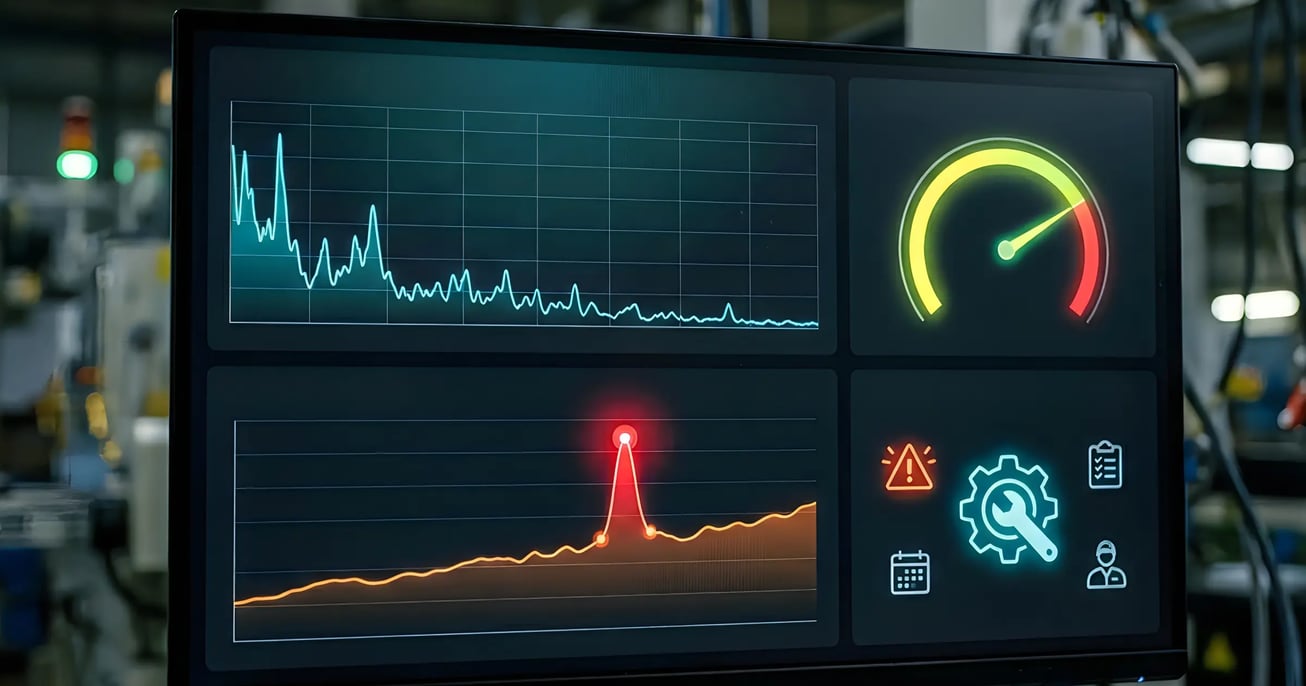
A dashboard reports that a number moved. Finding out why it moved requires production records that arrive already connected to the product built, the process followed, the materials consumed, and the equipment that ran the job.
First pass yield on line two is down four points over three weeks. It's on the Monday review slide, in red, and everyone in the room can see it.
What follows is a round of theories. Somebody thinks it started after the new operators came on. Somebody else remembers a material lot that ran short in early October. The engineering manager mentions a revision that went out around then. Maintenance points out the same line had two unplanned stops that month. Every one of these is plausible. Nobody in the room can rule any of them out, so the meeting ends with three people assigned to go look into it and report back.
That report takes two weeks and consumes most of a quality engineer's time, most of which is spent pulling records rather than analyzing them.
Why a Dashboard Shows the Yield Drop but Not the Cause
For years, manufacturing intelligence has effectively been measured by the quality of its dashboards. Better reports, faster refresh, more KPIs, more granular filtering. Those improvements are real, and monitoring an operation today is genuinely easier than it was a decade ago.
But a dashboard tells you a number moved. It rarely tells you why it moved, or whether the movement matters given everything else that happened that month. Yield dropped four points is a fact. Whether that fact is a supplier problem, a process problem, a training problem, an equipment problem, or three small things interacting is a different question, and it's the only one worth answering.
That distinction is the whole difference between measuring performance and improving it. Manufacturers don't get better by watching numbers more closely. They get better by understanding the relationships behind them.
Why Tracking More KPIs Made This Harder, Not Easier
The instinct when a number is hard to explain is to measure more things, and manufacturing has followed that instinct enthusiastically for twenty years. Most plants now track more indicators than any individual can hold in their head, which produces a specific failure that does not look like a failure.
With enough measures on a screen, something is always moving. Several things are always red. The morning review becomes an exercise in deciding which red items to ignore, and that decision gets made on instinct rather than evidence, because nothing on the screen indicates which movements are connected to each other. Two indicators that both dropped in the same week might be the same problem or two unrelated ones, and the dashboard is silent on the question it most needs to answer.
So the plant ends up with more measurement and no more clarity, and the people in the room get slightly more comfortable dismissing information, which is the opposite of the intended effect.
How an Experienced Production Manager Actually Investigates
Sit with a production manager working through a yield problem and the striking thing is how little time they spend on the dashboard. They glance at it to confirm the problem is real, and then they start connecting events.
What changed. When exactly did it start, to the day if possible. What else changed around the same time. Has this happened before, on this line or another one. Is it one shift or all of them. One product family or several. One machine. One material lot. One operator. One customer's configuration. Anything upstream that would have reached this station without anyone thinking about it.
Every one of those is a question about relationships rather than about a number. Experience teaches people that the answer almost never lives in a single report, because the cause almost never lives in a single system. It lives in how a material lot, a revision, an equipment condition, and a shift pattern happened to line up during a particular three-week window.
That's why the yield investigation takes two weeks. The manager knows exactly what to ask within about ninety seconds. Everything after that is retrieval.
Why Manufacturing Analytics Projects Stall at Data Collection
Most manufacturing analytics begins with isolated transactions that have to be assembled into a picture before anyone can interpret them. Records get pulled from engineering, the manufacturing execution system, quality, maintenance, ERP, and whatever spreadsheets fill the remaining gaps. Then somebody has to align them, which usually means matching on a work order number, a date range, and a certain amount of judgment about which records refer to the same physical thing.
By the time the picture is assembled, most of the effort went into collecting information rather than learning from it. And the assembled picture is usually good enough for one question. Ask a slightly different question next month and much of the work happens again.
Research from Tech-Clarity and MESA International in Making Manufacturing Analytics and AI Matter keeps landing on the same theme. Manufacturers already know there is more value sitting in their production data than they are getting out of it. The constraint isn't collecting more. It's preserving the context needed to interpret it consistently across the business.
This is also why analytics projects often deliver less than expected without anyone being able to say exactly what went wrong. The reporting works. The numbers are accurate. What's missing is the ability to ask a follow-up question without starting over, and follow-up questions are where the actual improvement lives.
One Production Event, Five Legitimate Questions
Part of what makes this hard is that no single interpretation of a production event is the right one. Take an operation completing on line two. Engineering wants to know whether the correct revision was followed, because a change went out recently and nobody is fully confident it reached every work center. Quality wants to know whether the required inspections happened at the specified points, not merely that they happened. Planning wants to know what it means for the next operation, since a downstream work center is already tight this week. Maintenance is wondering whether the equipment that ran the job shows the wear pattern that preceded a failure last month. Purchasing, if anyone thought to ask, would want to know whether the materials consumed match what was ordered, given a substitution approved last quarter.
Every one of those questions is legitimate and each belongs to a different person. Answering all five today usually means five people going to five systems, or one person going to whoever remembers. And that is one event. A mid-sized plant produces thousands of them in a shift.
A shared operational picture does not resolve the disagreement about what matters. Different functions should care about different things. What it removes is the requirement that each of them rebuild the surrounding facts privately before they can apply their own judgment.
What Changes When Production Records Arrive With Their Context
When every production event arrives already connected to the product built, the process followed, the materials consumed, the equipment used, the operator who ran it, the inspections that verified it, and the customer order behind it, investigation starts at the analysis rather than at the retrieval.
That isn't just faster. It's a different kind of question. When scrap starts climbing, a plant can determine quickly whether it tracks to a material lot, an engineering change, a recurring equipment condition, or a production sequence, because all four are already attached to the same events. When throughput drops, it can see whether the drop lines up with a new product introduction, workforce availability, growing product complexity, or repeated maintenance interruptions.
Back to the four points of yield. With the relationships in place, the question resolves in an afternoon rather than two weeks, and it resolves more precisely. Not because anyone got smarter, but because the production manager's ninety seconds of good questions can actually be answered at the speed he asked them.
The conversation moves from symptoms to causes, which changes what the Monday meeting is for. Instead of assigning three people to investigate, the room can spend its time deciding what to do about a cause it already understands.
What the Two-Week Yield Investigation Actually Found
It is worth finishing the yield example, because the resolution is more instructive than the delay.
The cause was two things at once, which is why nobody in the room could name it. A material lot with dimensions at the edge of tolerance was running through a fixture that had drifted slightly since its last check. Either condition alone produced acceptable output. Together they did not. The new operators had nothing to do with it, and the engineering revision was unrelated, though both theories survived the entire two weeks because nothing available could rule them out.
This is the ordinary shape of manufacturing problems. Single causes get found quickly, often by the person closest to the work, and rarely reach a Monday review slide. What reaches the slide is the interaction, and interactions are exactly what a set of disconnected records cannot show, because seeing them requires holding the material lot, the equipment condition, the process, and the output of a specific set of units in view at the same time. That is a relationship question wearing the costume of a statistics question. It is also why traceability that stops at genealogy stops short of the answer.
Where Your BI and Analytics Tools Still Fit
Analytics platforms are good at what they do, and a plant that has invested in one should not read any of this as a reason to reconsider. The visualization, the statistical work, the ability to move quickly across large volumes of records: all of it is genuinely capable and none of it is the constraint here.
The constraint sits upstream of the tool. A capable analyst working from records whose relationships were stripped out somewhere between systems will spend most of their time rebuilding those relationships by hand, usually through joins and assumptions that live in a query nobody else can review. The output looks authoritative. Whether it is depends on assumptions that are now buried in a script, and the person best positioned to challenge those assumptions is a production manager who will never see them.
Give the same analyst records that arrive with their context intact and the tool becomes substantially more valuable, because the analyst spends their time on analysis. The investment is not wasted. It is waiting on something underneath it.
Why Production History Becomes More Valuable Every Day
This is the part that compounds, and it's easy to underrate because it doesn't produce a result in the first quarter.
Each completed work order extends product history. Every inspection adds a data point about what the process is actually capable of. Every repair reveals something about how the product behaves once it leaves. Equipment events expose reliability patterns that are invisible in any single month. None of that is worth much on its own. Together it becomes accumulated manufacturing knowledge, and that is what actually separates plants that improve steadily from plants that keep solving the same problem every eighteen months.
The strongest manufacturers aren't the ones collecting more history than everyone else. Most plants have plenty of history. They're the ones getting more out of it, because their history arrived with its relationships intact and can therefore be asked new questions later, including questions nobody thought of when the data was captured.
That last point deserves weight. The value of a production record is rarely known at the moment it's created. A material lot number matters two years later when a field failure pattern emerges. An operator qualification matters when a customer audits. A repair record matters when the same defect shows up on a different product line. A record captured without its relationships can answer the question it was designed for. A record captured with them can answer questions that haven't been asked yet.
The Cost of Acting on the Wrong Theory
There is a practical consequence to living with a number you cannot explain, and it is worse than the delay.
A plant that cannot establish the cause of a four point yield drop will usually do something about it anyway, because doing nothing is not an acceptable answer at a Monday review. So it acts on the most plausible theory in the room. Sometimes the theory is right and performance recovers, which teaches everyone the wrong lesson about how the decision was made. Sometimes it is wrong, the number does not move, and the plant has now spent effort and credibility on a change that addressed nothing while the actual cause continued running.
The more corrosive version is the fix that appears to work. Yield recovers for reasons unrelated to the change, the change stays in place permanently, and the plant carries a procedure, an added inspection, or a slower cycle time that solves nothing and costs something every day for years. Most plants have several of these. Nobody can identify which ones they are, because the reasoning behind them was never captured either.
From Reporting What Happened to Improving What Happens Next
The shift is from asking what happened yesterday to asking what we have learned and how it should change the next decision. It sounds like a small rewording. It changes what intelligence is for. Documenting the past becomes a resource for improving the future, and the plant stops treating its own history as an archive.
Those relationships are either preserved at the moment of execution or reconstructed later at considerable expense, which makes this a question about what your MES records, not what your reporting tool displays.
FactoryLogix was built around that idea. Because products, processes, materials, equipment, quality, workforce, and production events are already connected through the Contextualized Manufacturing Foundation, manufacturing intelligence doesn't have to reconstruct the factory before it can analyze it. The relationships that give each event meaning are already in place, which means the analysis starts where the production manager's instinct starts rather than three weeks behind it.
This also sets up what most manufacturers want to do next. Before anything can recommend what should happen, it needs an accurate account of what already happened and why. That is what manufacturing intelligence provides, and it's the foundation the next post builds on, because the current conversation about AI in manufacturing tends to skip straight past it.
This post is part of the series The Factory That Thinks Ahead. The full argument, including what it takes to get production records that carry their own context, is in the whitepaper: The Factory That Thinks Ahead.
Keep Reading
- Manufacturing Explained: What Is MES?
- Manufacturing Intelligence, dashboards, analytics, and reporting built on connected production data
Sources
Tech-Clarity and MESA International, Making Manufacturing Analytics and AI Matter.