


5 Decisions You Should Validate Before They Hit the Shop Floor

On a daily basis, manufacturers make decisions that shape production performance. Can we accept another order? Should we expedite a key customer shipment? Do we need another machine, another operator, another shift?
Most teams rely on experience, spreadsheets, and educated guesswork to answer these questions, often learning whether their decisions were correct only after production reveals the consequences. By that point, schedules have shifted, materials are used, and the floor is already compensating for issues.
Manufacturing always changes. Most plants learn about it from an unhappy customer rather than from their own numbers.
Manufacturing Has Become the Shock Absorber for the Supply Chain
Discrete manufacturers build products from dozens or hundreds of individual components, and each one has to reach the right station, in the right order, at the right time. Customers want more variety, more configurations, and smaller order quantities than they used to, and lead times that were once measured in weeks are now measured in days, and even hours. The combination of more variants, smaller batches, and tighter delivery windows leaves less room anywhere in the process to absorb a late part, a changeover that runs long, or an operator who isn't available when the schedule assumed they would be. On top of that, sourcing has become more global and uncertain, making the whole picture harder to plan around.
Why Schedules That Look Fine on Paper Fall Apart on the Floor
Most planning problems aren’t caused by bad intentions. They come from everyday habits in manufacturing that people rarely question. Plans are often made in silos. Production scheduling, procurement, quality, and logistics each focus on their own priorities. A scheduler might create a good production plan, but if procurement isn’t told about a changeover, materials can arrive late. If quality holds up a batch, others may not know until a shipment is missed. Weekly or monthly meetings try to catch these issues, but by then, someone has already lost time or money.
Demand also gets planned in silos. A forecast a year out becomes a production plan a few months out, which becomes a detailed schedule a week or two out, and each step usually runs on a different tool, with a different definition of what counts as capacity. By the time a schedule reaches the floor, capacity has typically been overestimated more than once.
There’s also the way schedules are built. Many planning systems use an average run-rate on a resource calendar and call it a schedule. On paper, it looks perfect: everything is used fully, with no gaps. But this view doesn’t check if operators, technicians, tools, and materials are all available at the same time. An order might look fine on paper but can’t run because three things needed at 8am aren’t actually there. That’s when the real problems start, and it’s why planners often spend more time fixing the schedule than following it.
And underneath all of it, most schedules are still optimized for one number. Finance wants costs down. Production wants throughput up. Sales wants on-time delivery up. All three matter, and a schedule built around only one of them will hit that number and disappoint everyone else.
A process digital twin, a model that replicates the real system down to the operators, tooling, and rules that govern how work moves through it, is built to solve the resource-calendar problem directly. Instead of loading capacity into a weekly bucket, it schedules against the full timeline, checking at every step whether everything a task needs is available at that moment. What comes out isn't just feasible on paper. It's something the floor can run without rebuilding it by 9am.
Decision #1: Can We Accept This Order?
A request comes in on a Friday afternoon: an important customer wants to double their order from 400 units to 800. It's good news, and the instinct is to say yes. But that order was already tight, expected to ship July 31, and promised for August 1. Using the process digital twin to test the change before agreeing to it showed two things: the increase pushed three other orders past their promised dates, and the original order could no longer meet its promised date. That doesn't mean turning the business away. It means calling the customer on Friday afternoon instead of explaining things on Tuesday.
The alternative is the version most plants already know from experience: say yes on the call, then find out on Tuesday that two or three other customers are getting a late shipment because nobody checked what it would cost to fill this order and how it would affect the rest of the production schedule. Whether that trade-off is worth it depends on which accounts are involved. That's exactly the point: it should be a decision, not something that happens by default because nobody ran the numbers first. Better to know that Friday afternoon, before saying yes, than to find out from an unhappy account manager the following Tuesday.
Decision #2: Should We Expedite This Customer?
Every plant has lived through the hot job. In one scenario, work order #11, placed by a key customer, was bumped to the top of the queue, as it usually does when someone important calls. The immediate result looked good: that order moved to the front of the plan. The knock-on effect was less desirable. Testing the change first showed a wave of other orders slipping behind it, and on-time delivery for the whole plan dropped to 70%. Seeing that before committing to the change is what enabled the team put that job back in its original spot, instead of finding out about the fallout from customer calls a week later.
Nobody puts a line item on an invoice for the other customers who now ship late, but they feel it just the same, and eventually they call too. That doesn't rule out expediting. A plant can still say yes when a job genuinely warrants it, but with a clear view of what it costs everyone else.
Decision #3: Do We Really Need Another Machine?
In the model, a 23-workstation circuit board assembly line ran through an eight-week production plan, and on-time delivery was sitting at 70%, with 14 orders running late. A capacity heat map pointed to the placement machines as the constraint, running near full utilization for weeks at a stretch, while downstream steps, like functional test, sat with visible gaps.
Adding a fifth placement machine to the model took one line of data. Re-running the plan showed on-time delivery jump above 90%, and it also showed where the bottleneck moved next, into the reflow process. That's what simulating a machine purchase before making it gets you: the case for the investment, plus a preview of what to watch once the machine is running.
A request for a machine that costs six or seven figures is usually justified by a utilization report and a gut feeling that the floor is spread thin. Neither one tells you whether the purchase actually fixes the problem or just moves it downstream. Running it through the model turns that gut feeling into a number that finance can evaluate, plus a head start on the next capacity constraint, so you're not surprised by it again in six months.
Decision #4: Should We Add More Labor?
A through-hole assembly area portrayed a different story. Staffed by two operators around the clock, with three machines to cover, those two couldn't keep all three running at once, so time was lost even though the machines themselves weren't the bottleneck.
Switching those operators to a standard Monday-through-Friday schedule revealed another problem: work piled up over the weekend that the back end couldn't touch until Monday morning. This kind of gap is usually invisible to most scheduling tools since a weekly bucket doesn't distinguish between an operator who is available at 2 AM Saturday and one who isn't. Adding a third operator to the model, again just one data change, recovered a meaningful chunk of that lost time and pushed on-time delivery to around 73%, and the team could see that result before writing a job posting. That's the difference between hiring because the schedule genuinely needs the labor and hiring because the floor feels busy.
“The floor feels busy” is a common enough reason to open a requisition, but it doesn't hold up well in a budget meeting. Put it through the model instead, and that impression turns into a number: how much of the gap is a real shortfall versus a coverage problem a schedule change could fix for free. One of those is worth the headcount. The other isn't.
Decision #5: What Happens When Reality Changes?
Materials show up late. Equipment goes down. Both happened in the same set of test scenarios. A raw material shortage stalled placement work until a planned shipment of 12,000 units arrived on June 24, and the model showed exactly which orders would sit idle until then. Separately, a reflow oven failure meant a repair that would take the rest of the week, and running that downtime through the model showed immediately which customers needed a call, before a floor manager found out at the start of a shift and started solving it on a whiteboard.
None of this is unusual. It's a normal week on most shop floors. The value isn't in stopping any of it from happening. It's in knowing early enough to actually get ahead of it.
There's also a real difference between calling a customer to say their order will ship two days late, with a new date already worked out, and getting the call from that same customer asking why it hasn't shipped. The first keeps the relationship intact. The second costs you something.
Why Context Matters
None of this works without good data behind it, and that's the part that's easy to underestimate. A simulation is only as accurate as the information that feeds it, and in most plants that information is scattered across an ERP, an MES, a quality system, and a handful of spreadsheets that don't talk to each other.
FactoryLogix already holds a connected picture of what's being built: process, materials, equipment status, quality requirements, operator qualifications, and history. That covers what happened on the floor and what's happening on it right now. Simio uses that same data to test what happens next, before it happens. Between the two, you get the full picture: what happened, what's happening, and what's about to happen if a given decision goes through.
Manufacturers Want Greater Confidence Before They Commit
During the live "Before the Shop Floor Decides for You" webinar, we asked attendees one question: what would make the biggest difference in their operation right now?
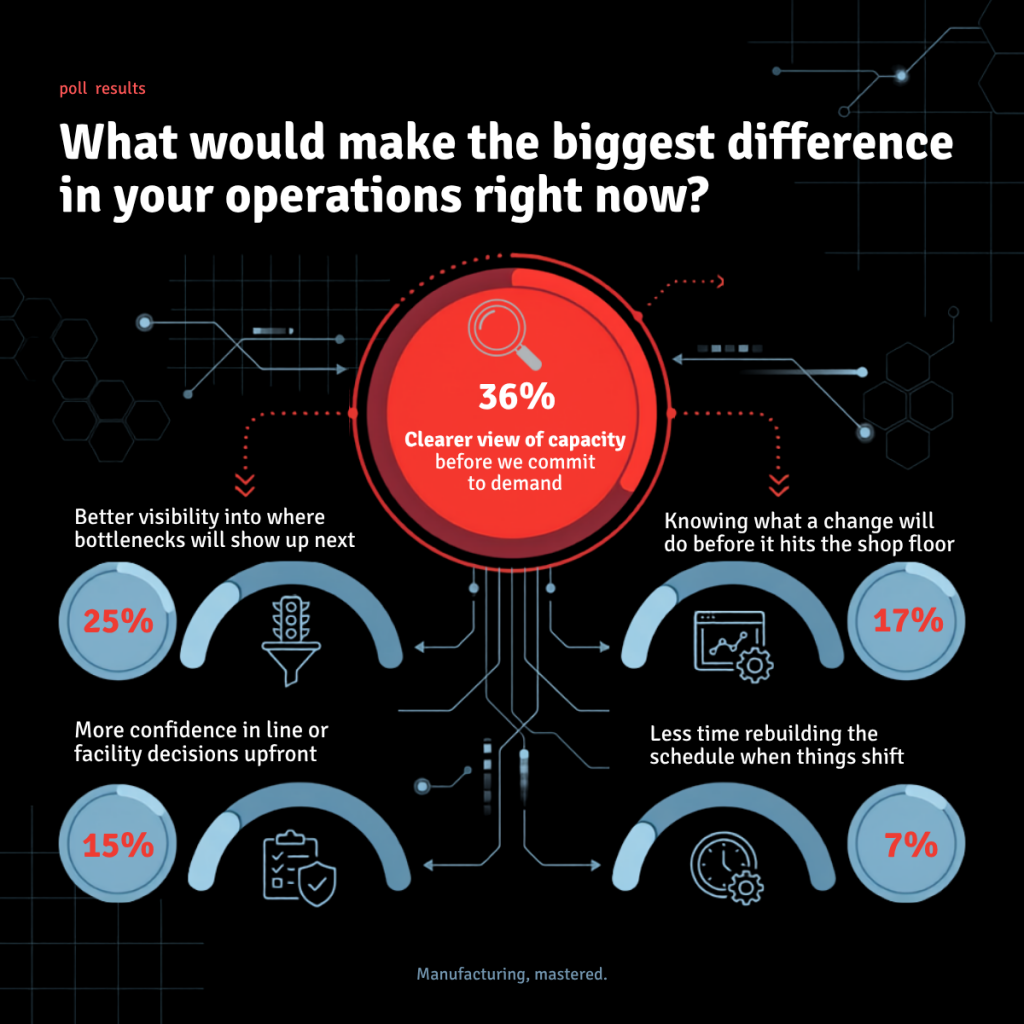
The top answer, by a wide margin: 36% wanted a clearer view of capacity before committing to demand. That's the same problem behind the order-acceptance scenario above: knowing before you say yes, not after.
The rest of the field:
- 25% wanted better visibility into where bottlenecks will show up next.
- 17% wanted to know what a change will do before it hits the shop floor.
- 15% wanted more confidence in line or facility decisions upfront.
- 7% wanted less time spent rebuilding the schedule once something shifts.
Different words, same ask: see the consequences before they happen, not after. That lines up with the scenarios walked through in the webinar itself. Rather than staying abstract, the session worked through how manufacturers can evaluate the impact of common operational decisions before they're executed: increasing customer demand, expediting a priority order, validating a capacity investment, accounting for a material shortage, and understanding the impact of a labor or equipment constraint. The message was consistent throughout: better decisions start with better visibility into what happens next, not after production begins, but before the change reaches the shop floor.
From Visibility to Confidence
Most manufacturers have already invested in knowing what happened yesterday and what's happening right now. Many already run an MES, a scheduling tool, or a stack of dashboards pulling reports together, and it's easy to assume that counts as being covered. But collecting the data isn't the same as connecting it. The harder, more valuable problem is whether that data is tied together, tied to the same orders, materials, and operators, in a way that can be used to test what happens next before a decision gets made. Many plants have the data. Fewer have it in a state where they can ask it a question and trust the answer.
Across the scenarios above, none of them required guessing. Materials, labor, shift coverage, a demand change, an equipment failure: six scenarios, six data changes, zero guessing. None of that is hypothetical. On most weeks, it's just Tuesday. The question was never whether these things would happen. It's whether you find out through your data or through your customers.
Watch the on-demand webinar: "Before the Shop Floor Decides for You" to see these five scenarios walked through live and see how FactoryLogix and Simio work together to test a decision before it reaches the shop floor.
Sign up for our blog
Stay up-to-date on the latest in manufacturing trends, insights and best practices.